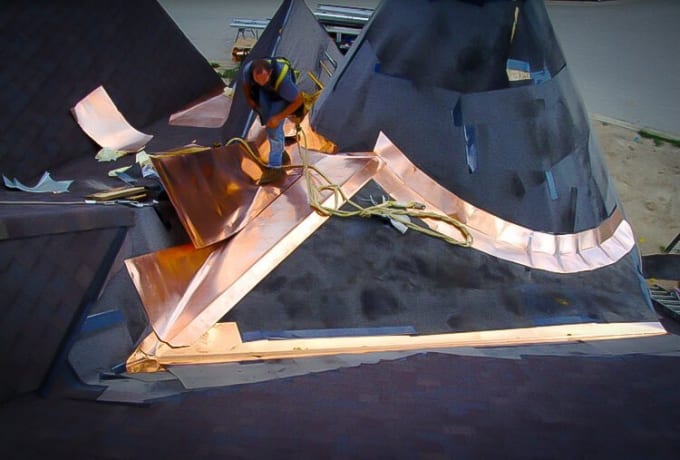
Most flashing hides. Some of it is meant to be seen. Copper and other architectural metal, bent by hand to fit your roof, can trace the lines of your home, protect its most leak-prone spots, and outlast the shingles around it many times over. Here's where decorative flashing makes sense, how copper changes color as it ages, and why we fabricate it to your roof instead of using stock pieces.
The short version
- Architectural flashing does a real job (keeping water out) while showing off a roof's angles, valleys and edges.
- Copper weathers from bright penny to brown and, over decades, to blue-green. That patina protects the metal underneath.
- Copper roofs and flashings well over 100 years old are common, so a copper accent can outlive several roofs.
- Pieces bent on site to your roof's actual measurements fit better, and look better, than factory shapes forced into place.
What is decorative flashing?
Every roof has flashing: the metal that seals valleys, walls, chimneys and edges, where shingles alone can't keep water out. Most of it is hidden under shingles or painted to disappear. (For the hard-working, hidden kind where roofs meet walls, see our guide to step and counter flashing.)
Decorative or architectural flashing is the kind you're meant to notice. Instead of hiding the metal, it puts it on display as a special channel that highlights the angles of the roof. Common places for it:
- Open valleys, where a copper channel runs down the V between two roof slopes
- Bay windows, porch roofs and dormers, often covered entirely in copper
- Chimney and wall flashings left exposed in copper rather than painted aluminum
- Roof edges and fascia, where metal trim gives a crisp line and covers the wood
- Cupolas, finials and ridge details that finish off the top of the house
It isn't always copper, either. Painted steel and aluminum trim can do the same job for less. One customer, Nicholas, wrote that our techs “installed metal flashing to cover up exposed roofing boards along the entire perimeter of our roof. Roof looks way nicer and is better protected.” That's the whole idea in two sentences.
How long does copper flashing last?
A long time. Writing for NRCA's Professional Roofing magazine, a regional manager for the Copper Development Association noted that many copper roofs and flashings are well over a century old, and that a copper roof can be expected to last 100 years or more. That's longer than any shingle roof will last, so a copper accent can outlive several roofs around it.
The secret is the patina. As copper weathers, it grows a thin film on its surface that protects the metal underneath, unlike rust on steel, which eats it.
See what metal accents look like on real homes.
Browse Hamstra roofs by town, from Orland Park to Frankfort.
Why does copper turn green?
Copper goes on bright and shiny, like a new penny. Within months it darkens to brown, and over the years it moves toward the blue-green you see on old church steeples (and the Statue of Liberty). According to the same Professional Roofing article, copper usually reaches a stable “weathering equilibrium” somewhere between 10 and 30 years, depending on climate and exposure. After that, the color stops changing but keeps protecting the metal.
That slow change is part of the appeal. As you settle into your home, the copper ages with it and shows its maturity. You can't buy that look on day one.
Why custom-bent flashing matters
Factory flashing comes in standard shapes and sizes, and installers often bend the roof's details to fit the part. We work the other way around. Our craftsmen understand how the material flexes, and they take flat sheets of copper and bend them to the measurements of your roof, not factory measurements bent to fit.
That matters for looks: clean, straight lines that follow the roof's actual pitch and angles. It matters for performance too, because a piece that fits doesn't need gobs of sealant to close the gaps. It's the kind of skill that gets passed down from one generation of roofers to the next, and it's part of how we train our crews.
One of the bigger projects we're proud of is a large copper front porch roof, where every panel was custom cut to match the porch's swoops and valleys. It took a long time to get everything right, and it was a proud moment to see it finished.
Is decorative flashing right for my home?
It's worth a look if:
- Your home has strong architectural lines (bays, turrets, dormers, steep valleys) you'd like to highlight
- You're replacing a roof anyway, so the flashing is coming off regardless
- You want a detail that will still look good, and still work, long after the shingles are gone
If you're planning a new residential roof, ask us about copper or painted metal accents during the estimate. We'll show you where they'd make the biggest difference, and where plain flashing is all you need.
Thinking about copper for your next roof?
Ask about metal accents during your free estimate. We’ll show you where they fit.
Questions we hear
What is decorative flashing on a roof?
Decorative or architectural flashing is metal, often copper, that is left exposed on purpose to highlight a roof's valleys, edges, bays or chimneys. It still does flashing's job of keeping water out of the roof's weak spots.
How long does copper flashing last?
Properly installed copper can last a century or more. Many copper roofs and flashings in use today are well over 100 years old, so copper often outlasts the shingles around it.
How long does it take copper to turn green?
Copper darkens to brown within months, then gradually moves toward blue-green over many years. It typically reaches a stable color somewhere between 10 and 30 years, depending on climate and exposure.
Is copper flashing worth the cost?
It costs more than aluminum or steel, but it lasts far longer and adds a distinctive look. It makes the most sense on homes with features worth highlighting, especially when the roof is being replaced anyway.
Family-owned in Frankfort since 1978: estimators, service techs, crews and the office that keeps it all moving. Meet the team