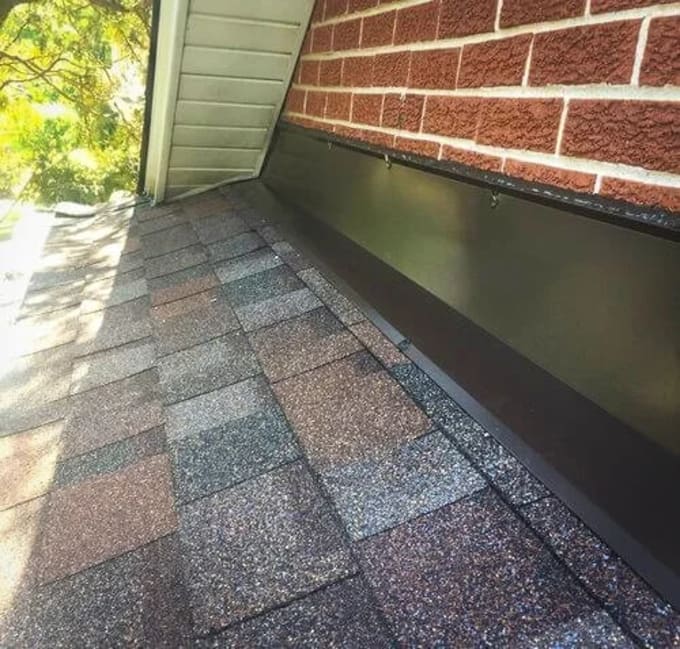
A roof works like a riverbed. Ridges and valleys direct the water, vents and chimneys stick up like rocks it has to flow around, and gravity always wins. Every layer of a roof is lapped so that water running downhill lands on top of the next piece, never behind it. Here's each layer from the deck up, what it does, and where roofs most often leak.
The short version
- Water flows down. Every piece of a roof overlaps the one below it so water is always carried over a seam, not into it.
- Underlayment is the hidden backup: ice and water shield at the eaves, valleys and around chimneys, with felt or synthetic underlayment over the rest.
- Most leaks start where the roof is interrupted: valleys, vents and pipe boots, and the places where the roof meets a wall or chimney.
- Flashing has to be tight to the corner and lapped correctly. Caulk is the final touch, not the main defense.
How does a roof shed water?
Think of your roof as a riverbed. The ridges and valleys direct the water. Vents, pipes and chimneys stick out like rocks the water has to flow around. The size and slope of the roof decide how much force that water carries: a big, steep roof sends a lot of water down its valleys in a hurry. And like always, water flows down.
Everything on a well-built roof follows from that one rule. Each shingle overlaps the one below it. Each piece of flashing tucks under the material above it and over the material below. As long as every lap points downhill, water runs off the roof the way it ran down the slope above it. Leaks happen where that order breaks, usually at a spot where something interrupts the roof.
What's under the shingles?
Starting from the bottom:
- The roof deck. The plywood or OSB sheathing nailed to the rafters gives the roof its shape and is what everything else fastens to. Some days the job means opening the deck for a skylight to make a room feel more natural. Other days it means closing a hole for a little less nature. Either way, soft or rotted decking gets replaced before anything goes on top.
- Drip edge. A strip of metal along the edges that steers water off the roof and away from the fascia. The model codes spell out the layering: at the eaves, underlayment goes over the drip edge; along the rakes, the drip edge goes over the underlayment. Both follow the downhill rule.
- Ice and water shield. A self-adhering rubberized membrane that seals around every nail driven through it. It goes at the gutter edge, where ice dams back water uphill, and in the valleys. It's just as important around chimneys and in small strips around vents. It's easy to shape, water-resistant and sticks tight, so it's a great material to overdo in heavy-flow areas and to wrap up corners. (Here's how far up the roof code requires it, and why we go further.)
- Underlayment. Felt or synthetic sheets cover the rest of the deck. You'll never see it, but it's your hidden helper: water that gets through a crack in the shingles can still be carried off the roof, if the underlayment was installed properly. That gives you more life out of your roof. Wondering which kind is better? We compare synthetic and felt underlayment honestly.
Not sure which layer is letting water in?
We’ll trace it from the ceiling to the attic to the roof and show you photos.
How are shingles installed so they don't leak?
Shingles are a layer of what's basically condensed sand bonded to asphalt, built to last 20 years and even up to 35, depending on the product. They work by overlapping, and the overlap starts at the bottom edge.
- Start the courses right. A starter course along the eaves puts a sealed, solid layer under the first row, so there's no seam for water to slip through at the edge. Know where the water will hit with the most force and reinforce it.
- Line them up from the beginning. Getting the first courses straight keeps the lines true all the way up and avoids a wavy look.
- Nail where the manufacturer says. Each shingle has a nailing zone. Nails too high, too low or crooked let shingles lift or let water reach the nail holes.
- Cap the ridge. Ridge cap shingles finish the peak and, on many roofs, cover the ridge vent.
Why are valleys and vents the most common leaks?
Because that's where the water concentrates or has to go around something.
Valleys catch the runoff from two slopes at once. They're one of the most common leaks, often from excessive nailing, not enough coverage or sloppy cuts. In the valleys, shingles need to be wrapped and cut properly to last through Chicago weather. Taking extra time for precision can save you thousands in the long run. Our valley tear-out story shows what that looks like when it goes wrong.
Penetrations are everything that pokes through the roof: bathroom fans, HVAC pipes, plumbing stacks, general exhausts. Water gets pushed around them, so they're a common spot to leak. Ventilation that comes through the roof often wears out over the years. It can be as simple as dry rot around a plumbing boot, or shingles worn down by the water flowing around a vent. Usually it's a simple fix, and proper flashing up front saves a lot later. (See our pipe boot leak guide.)
Ventilation deserves its own note. Make sure the roof has the right amount. Too little, and moisture can rot the inside of your roof from the attic side. The most common vents are ridge vents and “mushroom” box vents, and some homes upgrade to electric attic fans. The key is balanced intake and exhaust, calculated for your attic.
How is flashing done where a roof meets a wall or chimney?
Rain also flows along the sides of your house, against a wall or a chimney. To channel that water, metal has to be tight to the corner where the wall and roof meet, and it has to be cut, bent and installed so water can't seep behind it. Big leaks around chimneys and walls often come down to these little pieces.
- Step flashing. Purpose-made aluminum “tins” are woven in with each course of shingles where the roof meets the wall, tight in the corner. The model residential code calls for base flashing at least 4 inches tall and 4 inches wide against a sidewall.
- Counter flashing. After the tins go in, a steel or copper cap is cut to fit over them and into the brick, so water running down the wall lands on top of the step flashing, not behind it. A small level and sharp snips make the clean finish.
- Brick counter flashing. On a chimney, the counter flashing is set into the mortar joints and stepped to follow the slope. For the cleanest angles, use a small level to match the horizontal lines of the brick to the slope of the roof. Done right, it's a beautiful detail that highlights craftsmanship.
We go deeper on these in step and counter flashing where the roof meets a wall.
Where does caulk belong on a roof?
Last, and in small amounts. Once every piece of material is in its place, a tube of caulk goes over any weak spots as a final seal. A few places it earns its keep:
- Nail heads under replaced shingles, so nothing is left exposed after a repair.
- Where metal meets brick. Run a bead from metal to brick, then brick to metal, for the best water protection.
- Matched to the metal, so the finish looks clean and professional.
That's the basics of roofing. It's not that complicated in theory, and getting every detail right in practice is what we've done since 1978. We'll walk you through the process so you know what's happening and feel in control of your own roof. When the storms come, you'll really rely on it.
Planning a new roof?
We’ll show you every layer before it goes on, from the deck up.
Questions we hear
What are the layers of a shingle roof?
From the bottom up: the wood roof deck, metal drip edge at the edges, ice and water shield at the eaves and valleys, felt or synthetic underlayment over the rest, a starter course, the shingles, and ridge cap, with flashing wherever the roof meets a wall, chimney or vent.
Where do most roof leaks start?
Where the roof is interrupted: valleys, vents and pipe boots, skylights, and the flashing where the roof meets a wall or chimney. Open stretches of shingle leak far less often.
What does roof underlayment do?
It's a backup layer under the shingles. If water gets past the shingles, a properly installed underlayment carries it down and off the roof instead of into the deck.
What is the difference between step flashing and counter flashing?
Step flashing is small pieces of metal woven in with each course of shingles where the roof meets a wall. Counter flashing covers the top of the step flashing and is set into the wall or brick, so water running down the wall can't get behind it.
Can caulk fix a roof leak?
Only for a short time. Caulk is a final seal over properly lapped materials, not a replacement for them. It dries out and cracks over time, so a leak sealed only with caulk usually comes back.
Family-owned in Frankfort since 1978: estimators, service techs, crews and the office that keeps it all moving. Meet the team